 Classical music is deeply rooted in tradition, but the way it is recorded, shared, taught, and experienced continues to evolve.
The piano, recorded sound, radio, television, and digital streaming were all technological innovations in their time. Today, artificial intelligence represents the next step.
AI is not here to replace musicians, conductors, teachers, or creative directors. Its greatest value is helping them reduce technical limitations and focus more on the music itself.
AI Is About More Than Generating Music
When people hear “AI in music,” they often think of software generating new compositions. But many of AI’s most useful applications happen around the performance.
AI can support:
- Concert recording and live streaming
- Camera control and video production
- Score following and performance analysis
- Rehearsal and educational tools
- Digital archives
- Online distribution and audience engagement
In these areas, AI acts as an intelligent assistant rather than an artist.
Smarter Concert Production
Recording an orchestra is complex. A performance may involve dozens of musicians, changing instrumental sections, conductor cues, solo passages, and dramatic shifts in intensity.
Producing a professional multi-camera recording traditionally requires a large crew, detailed preparation, live camera operators, and significant post-production work. For many orchestras and concert halls, this makes regular high-quality recording difficult or expensive.
AI-assisted production offers a more efficient approach.
A music-aware system can combine the score, musician locations, camera presets, and a prepared visual storyboard. It can then help coordinate camera movements and shot changes throughout the performance.
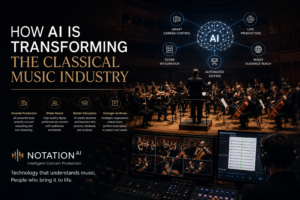
Notation AI brings these elements together in one workflow, including score integration, musician positioning, camera presets, storyboard preparation, live production, and automated editing.
The artistic direction remains human. AI helps execute that vision consistently.
Reaching Audiences Beyond the Concert Hall
A concert hall has a limited number of seats. A digital performance can reach audiences anywhere in the world.
Live streaming, on-demand libraries, educational platforms, and social media allow orchestras to connect with people who may never be able to attend in person.
High-quality digital content can support:
- Audience growth
- Music education
- Artist promotion
- Sponsorship opportunities
- Donor communication
- Social media engagement
- Historical preservation
However, building a strong digital presence requires consistent content production. When technology reduces the time and cost of recording and editing, more performances can become valuable digital assets.
Technology That Understands the Score
One of the most important areas of music technology is score following—the ability of software to recognize where musicians are within a score during a live performance.
This is difficult because musicians do not perform with perfectly fixed timing. Conductors change tempo, shape phrases, repeat sections, and make expressive decisions.
Modern systems can analyze live audio and connect it with the written score, even when the performance changes slightly.
For concert production, this creates an important opportunity. Camera decisions can be connected to the musical structure instead of relying only on fixed timing.
A system can prepare for a solo, shift attention between instrumental sections, or recognize an important full-orchestra moment.
The technology does not simply follow time. It follows the music.
Supporting Music Education
AI can also support students and teachers by analyzing rhythm, pitch, timing, and score position.
Students can receive immediate feedback between lessons and identify passages that need more practice. Teachers can spend more time on interpretation, technique, confidence, and musical expression.
AI should not replace music teachers. It should give them better tools.
Creating More Valuable Archives
Many orchestras have years of recorded performances, but those archives can be difficult to organize and reuse.
AI can help connect recordings with information such as the composition, conductor, soloist, movement, instrument, or important musical passage.
This makes it easier to find specific moments and transform full performances into educational videos, promotional material, or social media content.
Over time, a well-organized archive becomes more than a marketing resource. It becomes part of an institution’s cultural legacy.
Keeping People at the Center
The future of AI in classical music should be built around collaboration.
The conductor defines the interpretation. Musicians create the performance. Production directors establish the visual style. The organization decides how the concert should be presented.
AI supports the execution by coordinating technical systems, following the prepared structure, and reducing repetitive manual work.
Classical music should not be redesigned around technology. Technology should be designed around classical music.
Making Professional Production More Accessible
Large institutions often have the resources to maintain experienced production teams and advanced equipment.
The greater opportunity may be for regional orchestras, conservatories, festivals, concert halls, and smaller ensembles.
By making professional production more efficient and affordable, AI can help more organizations document their work, reach new audiences, support their musicians, and preserve performances at a quality that reflects their artistic value.
At Notation AI, we believe technology should become almost invisible—quietly supporting the performance while keeping musicians, creativity, and human expression at the center.
Discover how Notation AI can help your orchestra or concert hall capture, produce, and share performances with the world.